 Facebook
 X
X LinkedIn
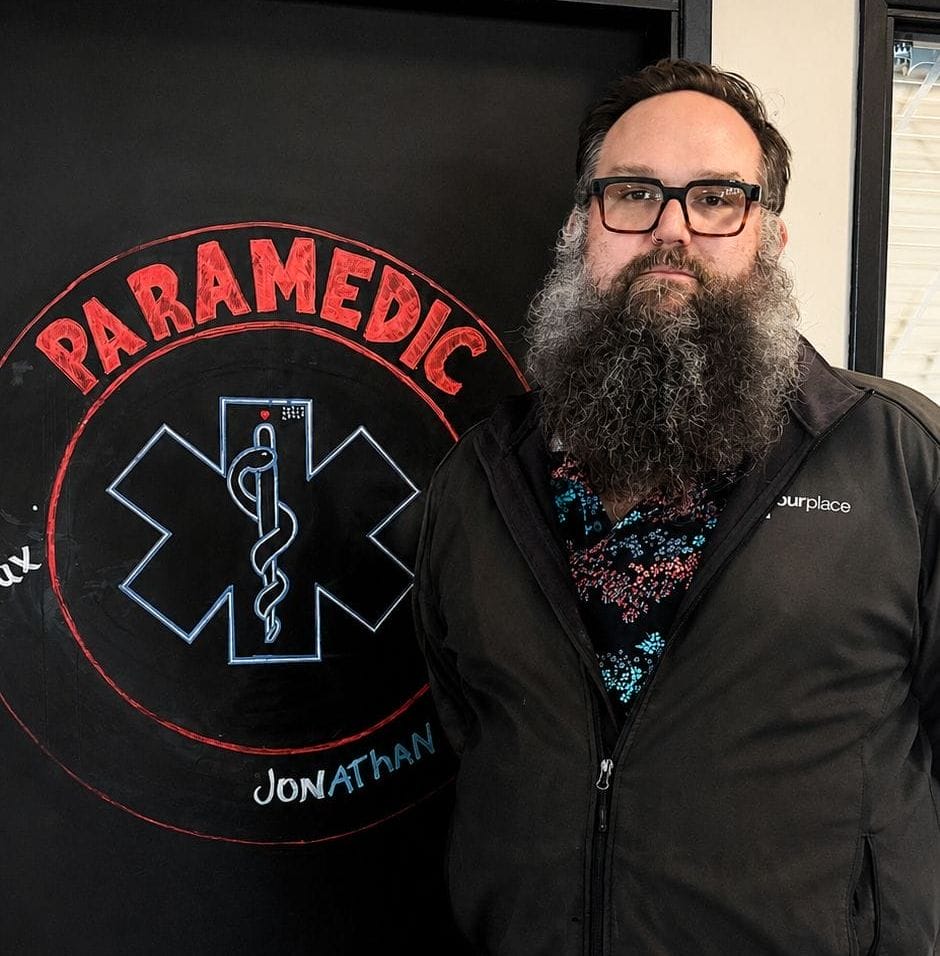
Jonathan’s Story
Jonathan never expected to stay at Our Place.
When he first became a paramedic, Our Place’s Community Centre was simply meant to be a steppingstone. A place to gain experience before moving on to BC Ambulance. Nearly a decade later, he can’t imagine being anywhere else.
“It was actually the job I wanted to do straight out of high school,” Jonathan says. “I was always involved in first aid and found the work really fascinating.
“Life, however, took him in a different direction. As the first in his family to attend university, Jonathan built a career in hospitality. He worked his way up through the industry and was even offered a management position in Edmonton.
But at 27, he found himself asking a difficult question.
“Is this really what I want to do for the rest of my life?”
The answer was no.
A chance conversation with a retired paramedic he worked alongside reignited his childhood dream. Soon after, Jonathan enrolled in paramedic training, eventually leading him to a position at Our Place Society. Initially, he thought the job would prepare him for a career elsewhere. Then he met the community.
“I started meeting the community and just kind of fell in love with it,” he says.
Today, nearly a decade later, Jonathan is still serving Our Place Family Members, and he can’t imagine doing anything else. “There’s something deeply rewarding about working down here. The help you get to give people on a daily basis is incredibly satisfying. It keeps me going.”
Many people picture paramedics as emergency responders who arrive, stabilize a patient, and transport them to the hospital. Jonathan’s role at Our Place is different from what many people imagine. “We work as Community Centre workers, outreach workers, or whatever you want to call it, as well as paramedics,” he explains. “Whilst we’re always going to respond to our medical calls, when we’re not doing medical things, we’re helping in the Community Centre.” That unique role allows Jonathan and his team to do much more than respond to emergencies. They treat wounds, respond to overdoses and medical crises, provide ongoing healthcare, and build trusting relationships with Family Members who may have been failed by or excluded from the traditional healthcare system.
By showing up day after day, they become familiar faces – people Family Members know they can trust.
Unlike traditional emergency medicine, Jonathan and his colleagues get to know the people they care for. They celebrate successes, support people through setbacks, and help connect Family Members to treatment, housing, and the many services available through Our Place’s Pathway of Support.
Over the years, Jonathan has watched countless people take those first difficult steps toward rebuilding their lives.
“There are definitely success stories of people we’ve responded to over the years,” he says. “Some have gone through treatment and gotten sober. Some are working here at Our Place now.” Jonathan is quick to point out that recovery is never the result of one person or one moment. But he knows that every life saved is another opportunity for healing, recovery, and a brighter future. The work isn’t always easy.
Every day, Jonathan sees people facing homelessness, addiction, trauma, and complex health challenges. He has witnessed the toxic drug supply become increasingly dangerous, making medical emergencies more difficult to manage and recovery even harder to achieve. Yet, despite the challenges, Jonathan wishes more people could see what he sees.
“I think there’s a big misconception that it’s a lot of violent people down here, and I think that’s pretty far from the truth,” he says. “I’m not going to pretend there isn’t violence, but most of these folks aren’t too different from you or me.”
He pauses before sharing a thought that has stayed with him throughout his years at Our Place.
“They could have ended up down here just as easily as someone else, if we took a left turn in life instead of a right turn at one point.”
It’s a reminder that homelessness, addiction, and hardship don’t define a person. They are often the result of circumstances that could happen to any of us. Instead of the stereotypes, Jonathan sees kindness. He sees people looking out for one another.
“I think there’s a lot of compassion fatigue out there,” he says. “People don’t like seeing suffering, and it’s easy to make assumptions. But for the most part, this is a very caring community.” It’s those moments of connection that have kept Jonathan at Our Place for all these years.
For him, being a paramedic isn’t just about responding to emergencies. It’s about meeting people where they are, treating them with dignity, and helping them find a path forward. At Our Place, that path can lead from a medical emergency to trust, from trust to support, and from support to a brighter future.
“I think it’s often an underrepresented role,” he says. “People see police and firefighters , but sometimes forget about paramedics.” He hopes people recognize the dedication and compassion that paramedics bring to their work every day, whether they’re responding to an emergency or building relationships that help someone take the next step toward recovery.
Because sometimes saving a life isn’t one dramatic moment- It’s treating a wound, reversing an overdose, sharing a conversation, or simply showing up again tomorrow.
Thank you, Jonathan, and to all the paramedics who serve our communities, for reminding us that some of the most powerful medicine we can offer is simply being there for one another.